Esencial
Foundations of suturing and wound care
The entry level. Free and complete.
Free
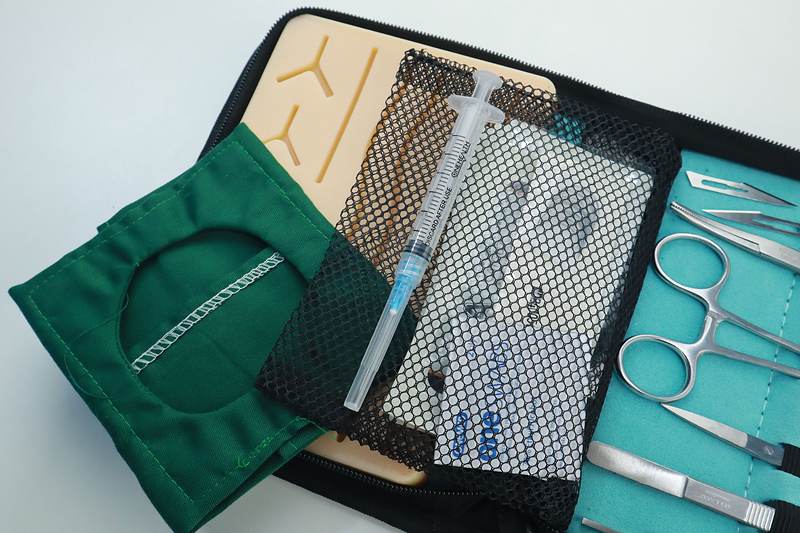
The Esencial level builds the base everything else rests on: understanding skin, recognising the wound in front of you, preparing a clean field, choosing the right material and placing a simple interrupted stitch with a solid instrument tie.
It is written for people who have never sutured, and for people who suture out of habit but never received structured training. Every lesson is short, with a verifiable objective, and every module ends in a test that requires 70% to pass.
From the first hour we insist on what is almost never taught: when not to suture. A badly closed wound does more harm than a wound referred in time.
Prerequisites: None. A practice pad and a basic suture kit are recommended.
What you will be able to do
- Describe the layers of the skin and the four phases of healing, and explain what delays each one.
- Classify a wound and decide, on explicit criteria, whether to close it, leave it to heal by secondary intention, or refer it.
- Prepare a sterile field, wash your hands and glove up without contaminating yourself.
- Name and use the basic instruments: needle holder, Adson forceps, Mayo scissors, Kocher clamp.
- Choose thread, gauge and needle according to body site.
- Infiltrate local anaesthetic safely and recognise its limits and contraindications.
- Irrigate, clean and perform simple debridement before closing.
- Place a simple interrupted stitch with a well-seated instrument tie.
- Remove sutures at the right interval for each site and detect complications.

Syllabus
Module 1 — Foundations: skin, healing and the decision
Before touching a needle holder you must know which tissue you are facing and whether that wound should be closed at all.
- Skin anatomy and the phases of healing — Which layers your needle crosses, and what the body does over the following weeks.
- Types of wound and when NOT to suture — Explicit criteria for closure, secondary intention and referral.
- Module test
Module 2 — Asepsis, instruments and suture material
The field, the hands, the forceps and the thread. Half the result is decided here.
- Asepsis: hand hygiene, sterile field and gloves — The barrier between a clean scar and an avoidable infection.
- Basic instruments — Needle holder, Adson forceps, Mayo scissors and Kocher clamp: what each is for and how to hold it.
- Sutures, gauges and needles — Absorbable or not, monofilament or braided, which size to use and which needle to ask for.
- Module test
Module 3 — The procedure: anaesthesia, cleaning and the simple stitch
The full sequence, from infiltration to the instrument tie.
- Infiltrative local anaesthesia — Which agent, how much, how to give it and what the safety limits are.
- Cleaning, irrigation and simple debridement — The step that reduces infection the most, and the one most often cut short.
- Simple interrupted stitch and instrument tie — The fundamental move: entry, path, exit, eversion and knot.
- Module test
Module 4 — Follow-up, removal and glossary
What happens after closure, and what everything is called in five languages.
- Suture removal and timing by body site — When to remove, how to remove and what to watch for afterwards.
- Multilingual visual glossary — The vocabulary of suturing in Spanish, English, French, Italian and German.
- Module test